Building a Simple Low-Field MRI Scanner
A hands-on workshop
Experts of the month
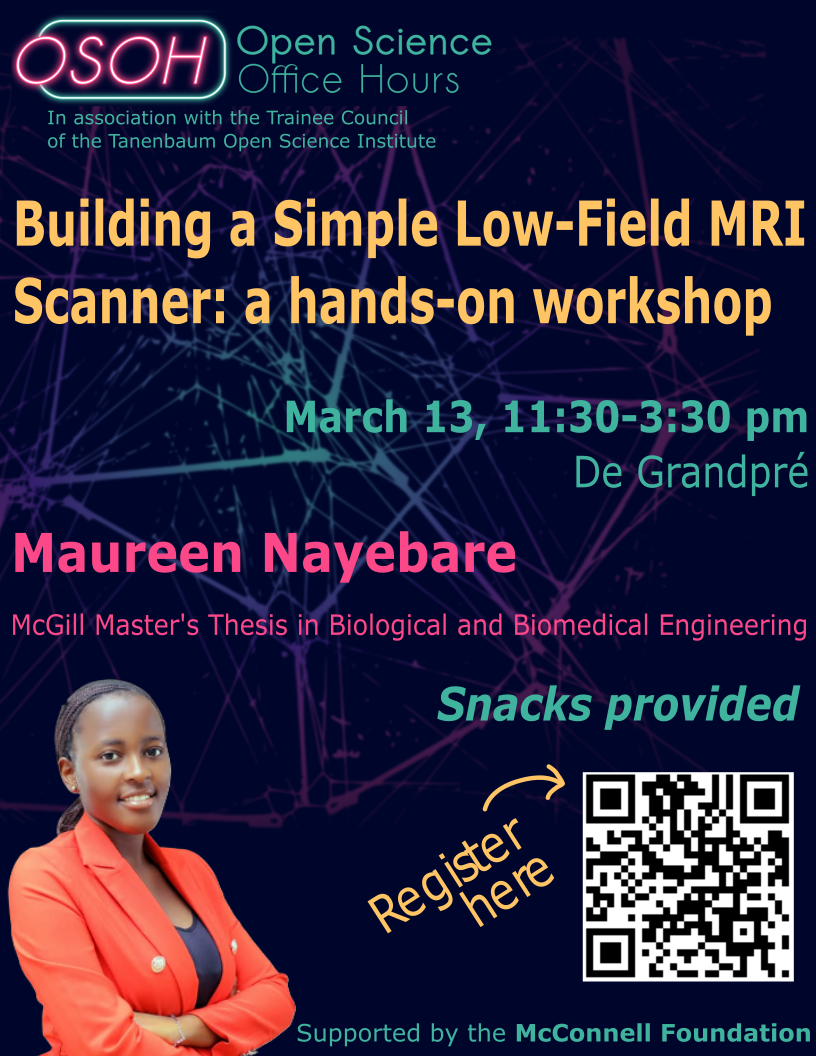
Master's Thesis in Biological and Biomedical Engineering.
Maureen Nayebare is a Ugandan electrical engineer, researcher, and biomedical engineering innovator specializing in open-hardware applications for low-field MRI in healthcare, primarily in low-resource settings. She holds a bachelor’s degree in electrical and Electronics engineering from Mbarara University of Science and Technology, Uganda, where she also participated in the build of a 50mT low-field MRI scanner for imaging children with hydrocephalus under MRI-Uganda. Maureen is currently a master candidate in Biological and Biomedical engineering, and her thesis is developing an immersive hands-on educational toolkit for low-field Magnetic Resonance Imaging (MRI).
She is part of the IMAGINE Summer School coordinators, where she helped train participants to build a rat brain imaging MRI scanner at The Neuro (Montreal Neurological Institute (MNI)), McGill. She then worked alongside some of the Imaging Without Borders Summer school (IMAGINE) trainees to develop a frugal educational toolkit (ERNIE-ESMRMB-IMAGINE MRI Education toolkit) for on-site construction of a 50mT OS-LF ‘mice-like’ brain MRI scanner that can be readily reproduced in any setting with common assembly tools and no prior MRI engineering background.
With support from the Tanenbaum Open Science Institute under the Supervision of Prof. Udunna Anazodo, Maureen led a hands-on educational workshop at The Neuro under the Open Science Office Hours Team, where they trained participants on how to build an MRI scanner and map its field using a robotic field mapper. She worked alongside Dr Haile Baye Kassahun, a postdoc researcher at The Neuro, and Guillermo Sahonero Alvarez, a PhD student at the Institute for Biological and Medical Engineering in UC Chile. The team also conducted open science and open hardware workshops at Polytechnique Montreal, The Douglas Hospital, Montreal General Hospital, and McGill Schulich Library to test the reproducibility of the ERNIE toolkit and to advance hands-on MRI education in collaborative settings. She will be conducting a similar workshop at the ISMRM 2026 conference to equip participants with more knowledge in low-field MRI. Her work focuses on building scalable, reproducible, and accessible MRI systems and educational tools that expand hands-on training and open science capacity globally.
Postdoctoral researcher at The neuro.
Haile Baye Kassahun received the B.Sc. degree in electrical and computer engineering and the M.Sc. degree in biomedical engineering from Addis Ababa University in 2013 and 2017, respectively. He received the Ph.D. degree from the Department of Systems and Biomedical Engineering, Cairo University. He worked as an Assistant Lecturer with the Center of Biomedical Engineering, Addis Ababa University, from 2014 to 2017. He is currently a postdoctoral researcher at Montreal Neurological Institute (MNI), McGill University. His research interests include MRI gradient coil design, low-field MRI, medical imaging, and biomedical image processing.
Mechatronics Engineer. Doctoral candidate, Institute for Biological and Medical Engineering, Pontificia Universidad Católica de Chile
Guillermo Sahonero Alvarez is a Mechatronics Engineer and a doctoral candidate at the Institute for Biological and Medical Engineering of the Pontificia Universidad Católica de Chile. His research focuses on MRI simulation and the optimization of sequence parameters, particularly for low-field (LF) and ultra-low-field (ULF) brain imaging. Originally from Bolivia, where he served as a full-time university lecturer and researcher for four years, he is now affiliated with the Center for Biomedical Imaging (CIB) and the Millennium Institute for Intelligent Healthcare Engineering (iHEALTH). He contributed to the open-science MRI community as a committee member of the “MRI Together” initiative, an ESMRMB initiative, and through the development of the ERNIE-ESMRMB-IMAGINE MRI education toolkit. He enjoys programming in Julia and Python, as well as working with computer vision, machine learning, and computational models.
Seminar/Workshop
Friday, March 13, 2026 at 11:30-3:30 pm EST
de Grandpré Communications Centre, the Neuro (Montreal Neurological Institute-Hospital).
*Click here for directions
Are you curious about how brain MRI scanners are made? Join us for a fun, hands-on Open Hardware workshop where we’ll explore the basics of low-field MRI engineering and assemble a simple brain MRI scanner! In this interactive 4-hour session, we shall start with a brief introduction to brain imaging hardware, followed by a step-by-step guide to build a scanner. At the end of the workshop, you will measure and characterize the magnetic field of the scanner using a 3D field mapping robot that you will also assemble yourselves. No prior hardware experience is needed!- Just curiosity and willingness to learn.